


Why Puzzles, Not Exercises?
At school, kids can get the impression that maths is about memorising techniques and applying them, over and over. They (quite rightly) say that this is boring.
Here’s the secret: real maths is creative. It’s about curiosity, imagination, and solving problems for the fun and, yes, beauty of it. When mathematicians “do maths”, it’s nothing like the exercise below, and a lot more like the puzzle.
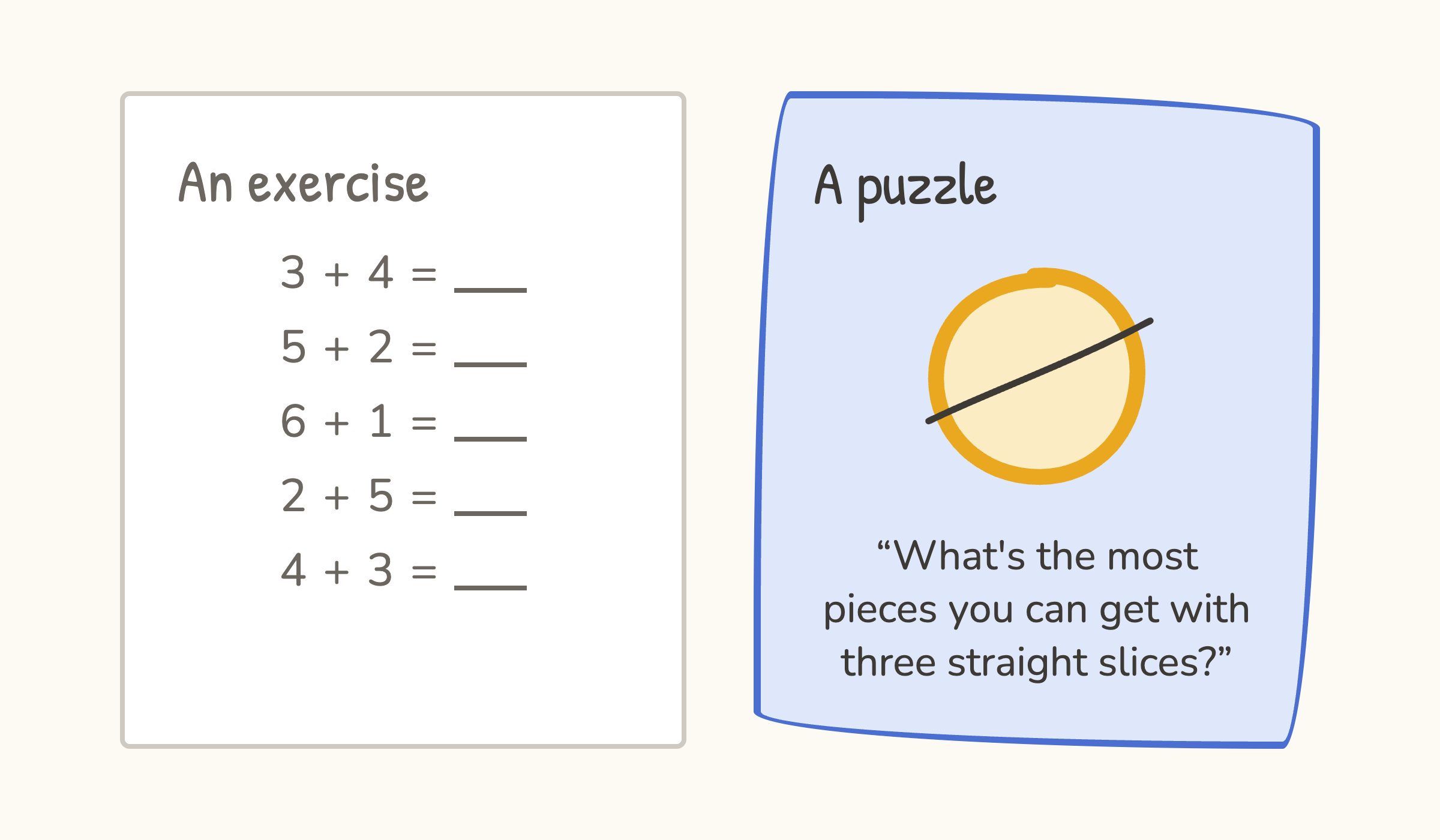
We want to allow more kids to experience creative problem solving. Not just because we believe it gives them greater confidence with maths, but because it’s fun in of itself!
What are Pancake Puzzles?
Every week we post a playful puzzle designed to develop kids’ intuition for shapes, patterns, sequences and much more (ok, numbers too). Each puzzle relates to an established branch of mathematics, building confidence with the core concepts, though the kids don’t need to know that.
The puzzles are designed to be done with pen and paper, together at the kitchen table (pancakes are a bonus). But no need to panic - all puzzles come with guidance and handy tips for the adults! No maths experience is required.
Each puzzle has 3 difficulty levels. This gives a “low floor, high ceiling”, so younger kids can engage with the puzzle while still stretching older ones.
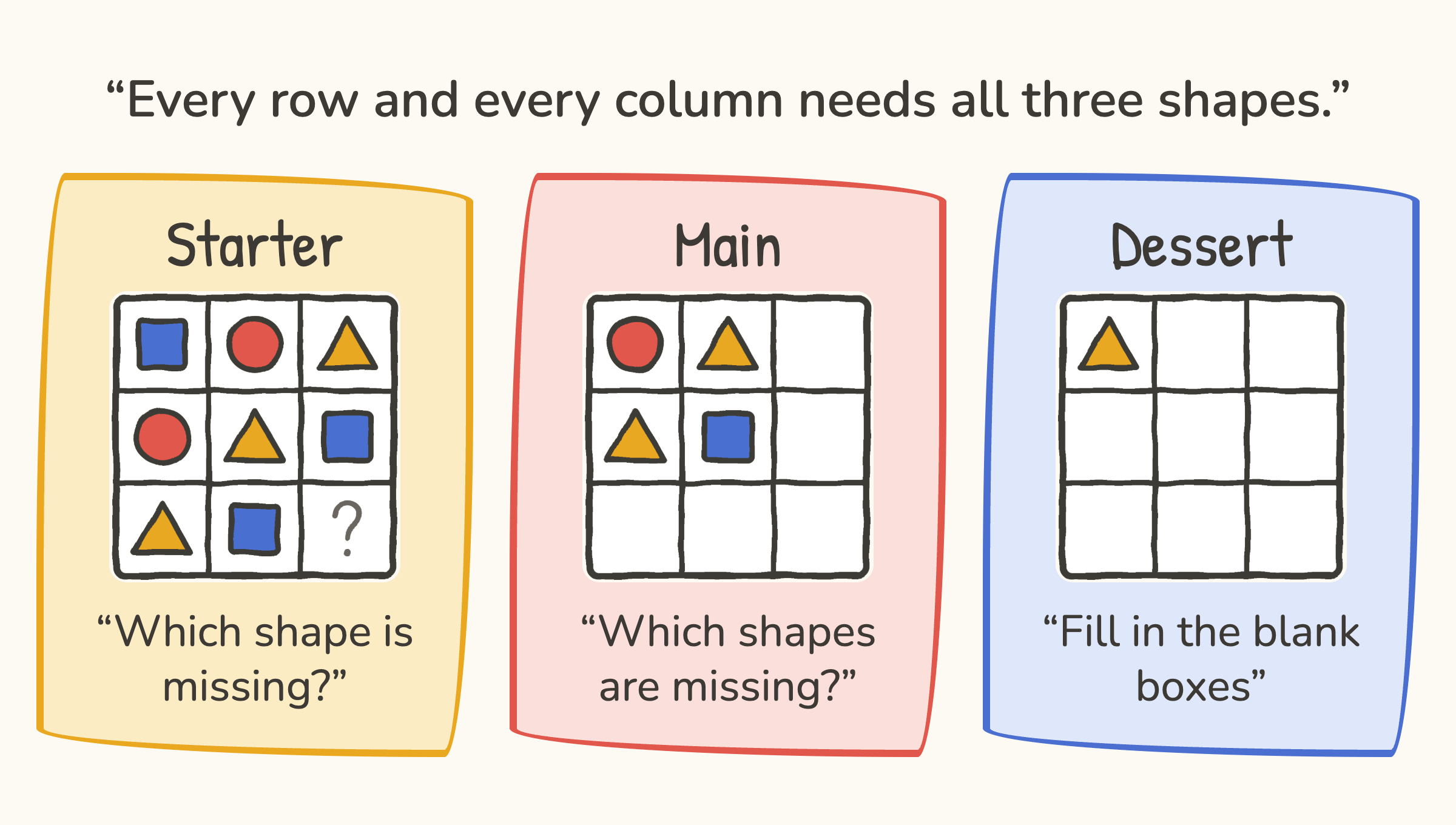
Click here for a full example puzzle.
What do grown-ups need to do?
We all have a burning desire to make sure kids get the right answer. If they make a mistake, we think we’ve failed. We try to be clever and give them hints. “How can that BE? We already have a square in that row. So the answer must be a tri…?”
Unfortunately, they usually can’t understand your logic at this age. Instead, they will likely stop trusting their own instincts, and start guessing at the answer you want.
Part of doing puzzles with kids is learning how to be a good guide to them: helping to engage their curiosity, without lecturing or giving the answer. We give tips on this with each puzzle, based on our own kitchen table experiences. In general our principles are:
Questions are more important than answers. Even if a puzzle is answered incorrectly or left unfinished, kids will continue turning it over in their minds. You might find they give you the answer unprompted weeks later!
Avoid direct hints, but offer your own guesses. Hints tend to close down the child’s thinking. Making your own “guesses” at the puzzle models the thought process and curiosity, without handing an answer.
Celebrate all ideas, not just right answers. Getting it right is satisfying, and deserves a high-five, but we’ve found too much praise for right answers can mean the child gets quickly disheartened if they’re not sure. We want them to enjoy the creative struggle too - discussing all ideas enthusiastically helps a lot with this.
Who writes these?
I’m Mark 👋. I have two kids and I’m trying to get them excited about the creative side of maths. The puzzles on this site are ones they’ve enjoyed! Many of them are sourced from public collections and then tailored to the age group. The guidance comes from my experiences at the kitchen table so far. (I’m still very much learning how to be a good guide.)
I’m not a mathematician, though I have done a fair amount of maths - I have a master’s in physics and have tutored maths for several years. Most of the maths I have done has been of the “apply this” sort, rather than creative problem-solving. I want my kids to have a different experience!