


Introducing the puzzle
Say: “If something plus something is 2, what is the something?”
(I’ve found this works better than longer explanations, but you can also try “Each shape is secretly a number - you have to figure out which number.”)
Draw: The sums below, one at a time. They can write the answers once they’ve seen you do it once.
Starter
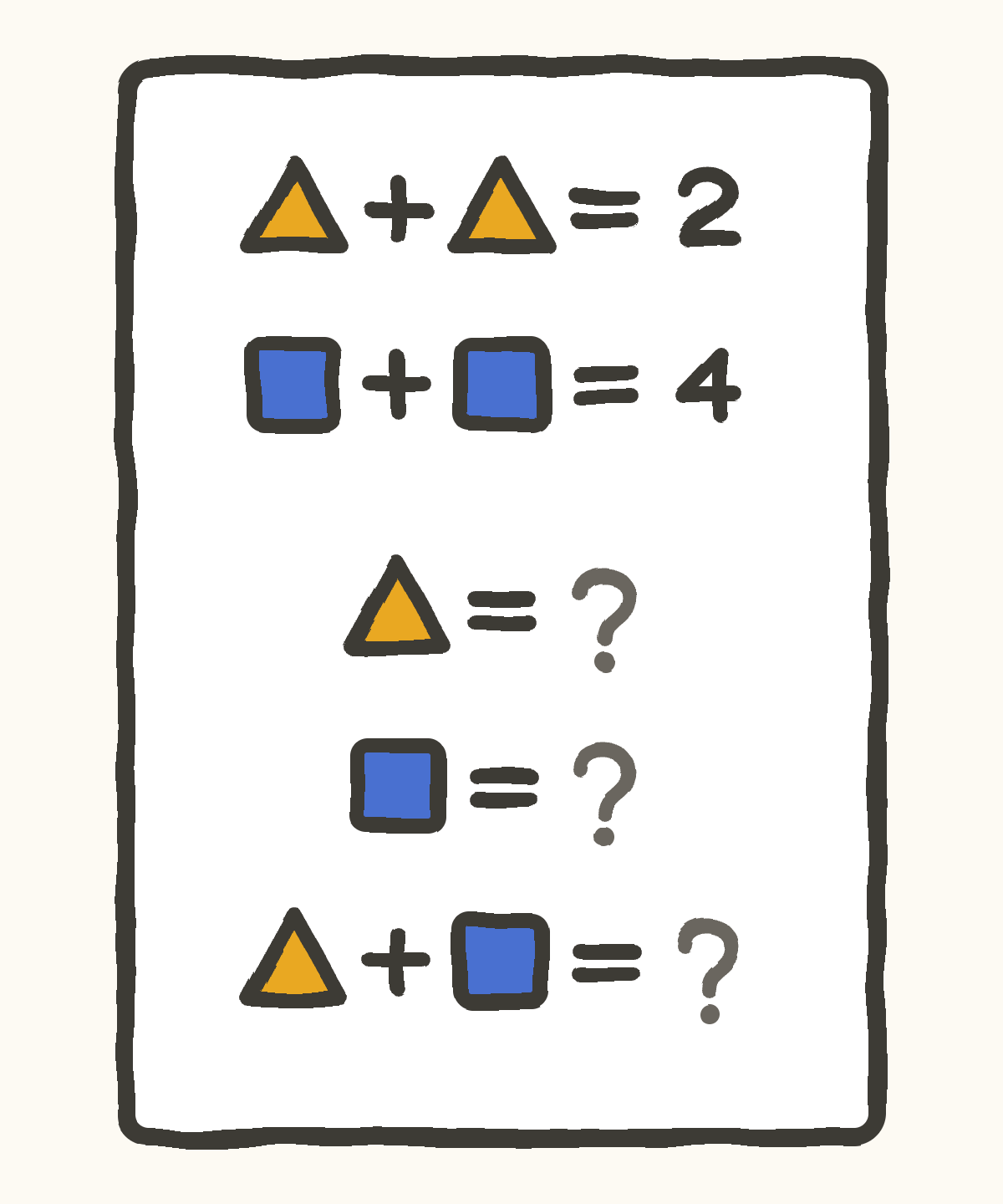
“If triangle + triangle is 2, what is triangle?”, etc.
Main
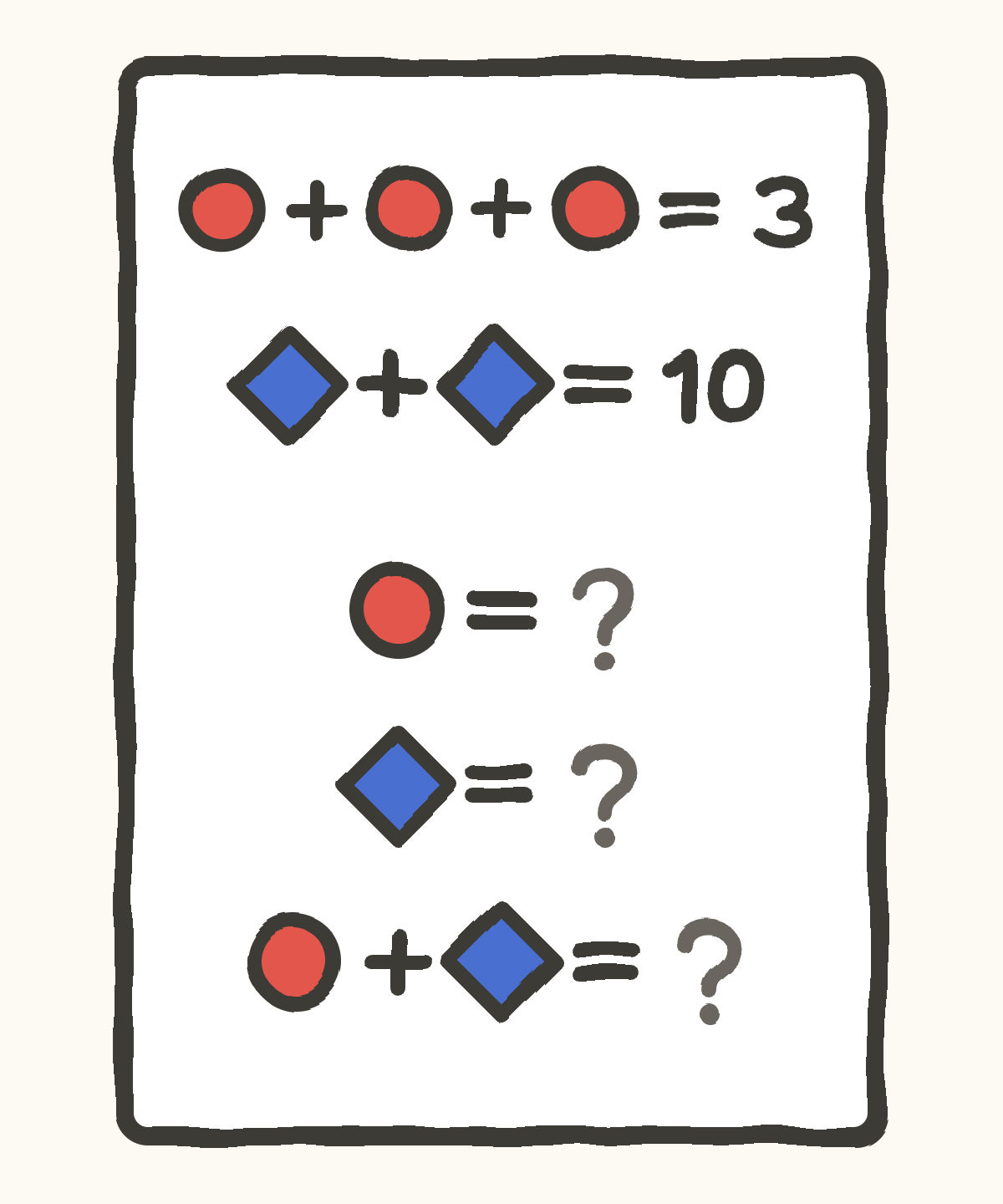
“If circle + circle + circle is 3, what is circle?”, etc.
Dessert
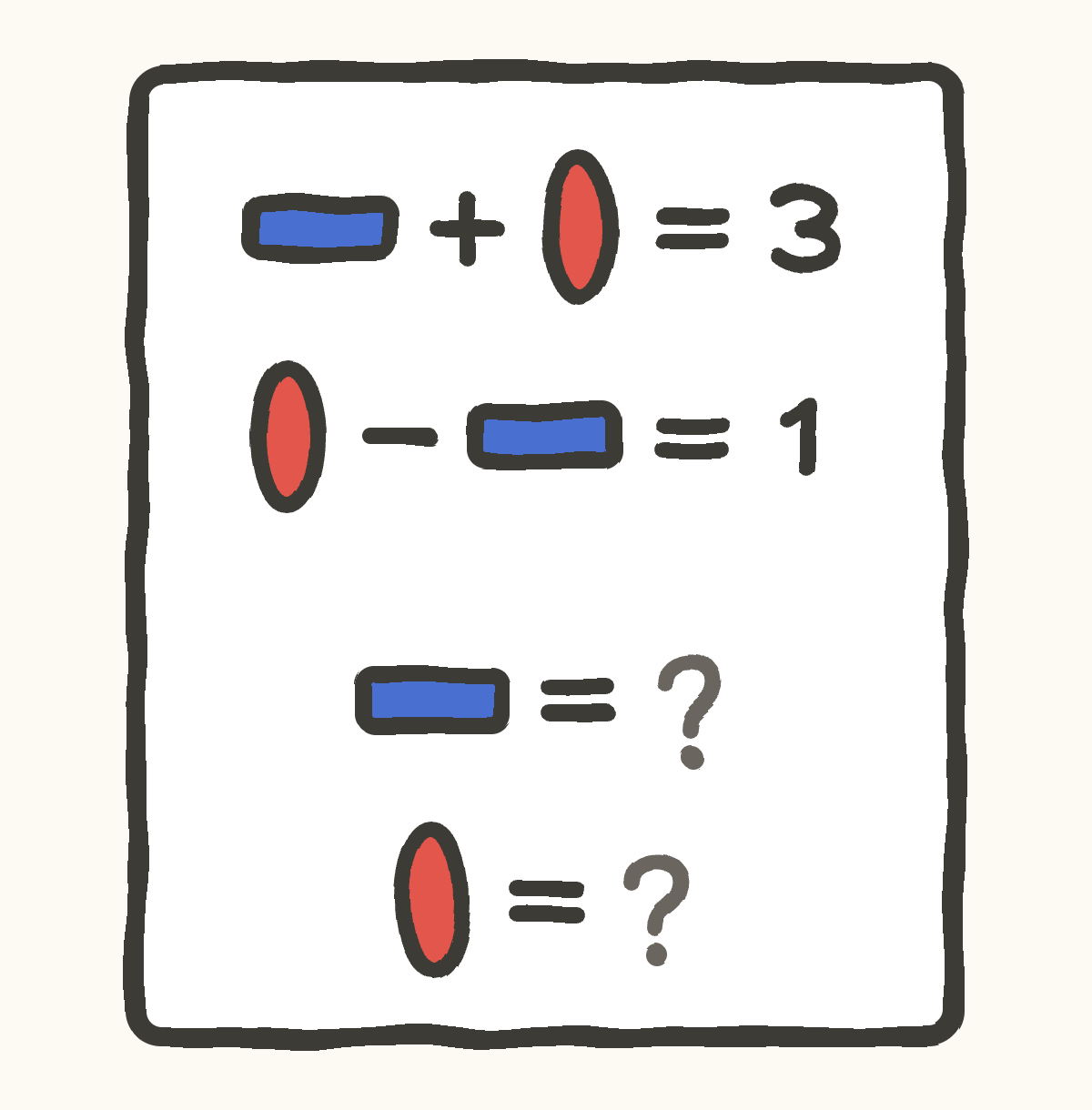
“If rectangle + oval is 3, and oval - rectangle is 1, can you guess what numbers oval and rectangle are?”
Tips for grown-ups
If they’re struggling, try making your own wrong guesses. “Ok so I think triangle might be 3. Let’s try that: 3 + 3 = 2… ? Is that right?”
Remember that questions are more important than answers. It’s ok if they don’t get it - they will keep turning it over and next time will be much easier! Switch to a more familiar puzzle if you need to.
Try asking them to “make up a shape sum for me.”
Branch of mathematics
Algebra. This is the study of relationships. Instead of letters or Greek symbols, we can just as well use shapes. The Dessert puzzle is an example of simultaneous equations, usually introduced in school around age 14.
Answers
Starter: triangle is 1, square is 2, so triangle plus square is 3.
Main: circle is 1, diamond is 5, so circle plus diamond is 6.
Dessert: rectangle is 1, oval is 2.
Let us know how it went!